
Welcome to ABSN.org
Welcome to ABSN.org, your go-to source for comprehensive information on Accelerated Bachelor of Science in Nursing (ABSN) programs.
Whether you’re transitioning into nursing from another career or seeking to fast-track your entry into the nursing profession, ABSN.org is here to support you.
Explore our extensive resources, connect with experienced professionals, and discover the pathway to a rewarding and impactful career in healthcare. Take the next step towards becoming a highly skilled and compassionate nurse.

✦ Find Your Perfect ABSN Path
ABSN Match — Your Personalized Program Guide
Built for career changers weighing a major decision. Answer 8 questions and get your ABSN readiness score, a matched program type, and your best-fit state and career path — in under a minute.
 Only 60 seconds
 Discover ABSN Programs That Fit Your Needs
 No email required to see results
Question 1 of 4
What's your current education status?Why we ask: ABSN programs require a non-nursing bachelor's degree — this is the #1 disqualifier.
← Restart Quiz
Question 2 of 4
What was your bachelor's degree in (or will be in)?Why we ask: Your prerequisite gap depends heavily on your prior major — and this shapes your timeline.
← Restart Quiz
Question 3 of 4
How soon do you want to start?Why we ask: ABSN application cycles are competitive — your timeline determines what's realistic.
← Restart Quiz
Question 4 of 4
Where do you see yourself 5 years after becoming an RN?Why we ask: Your end goal can shape whether you should aim for an ABSN, ABSN-to-MSN bridge, or specialty-focused program.
← Restart Quiz
ADN (Associate Degree in Nursing)
A 2-year community college pathway to RN licensure — the most affordable entry into nursing without a bachelor's already in hand.
Based on your education status, an ADN is likely your fastest, most affordable entry into nursing. Two years at a community college, then the same NCLEX-RN that BSN graduates take. Same license, different starting credential.
The honest tradeoff: Many larger hospitals and magnet-designated systems now prefer or require a BSN. Most ADN grads plan from day one to complete an RN-to-BSN bridge later — often online, often while working.
Best fit if:
- You don't yet have a bachelor's degree
- Cost and accessibility are top priorities
- You're open to bridging to a BSN later, often online
- You want to start working as an RN as soon as possible
← Restart Quiz
Your Best-Fit Path: Traditional Accelerated BSN
A 12-16 month, full-time pathway that takes your existing bachelor's degree and turns it into an RN license — fast.
The most direct route from a non-nursing bachelor's to an RN license. Same coursework, clinicals, and NCLEX prep as a four-year BSN — compressed into roughly a year.
The honest tradeoff: ABSN is intentionally relentless. Most programs strongly discourage working during the program, and the pace is unforgiving.
Best fit if:
- You have (or will soon have) a non-nursing bachelor's
- You can commit to full-time study with limited outside work
- You want to be working as an RN within ~18 months
- Bedside or hospital nursing is your starting goal
Explore Traditional ABSN Programs
← Restart Quiz
Your Best-Fit Path: ABSN-to-MSN Bridge Program
A longer but strategic pathway for career changers aiming straight at advanced practice — combining your accelerated BSN and master's into one streamlined program.
You signaled something important: you don't just want to become an RN, you want to become an advanced practice nurse. A bridge program flows you directly from accelerated BSN coursework into MSN-level study — often saving a year or more vs. doing it in two separate applications.
The honest tradeoff: Bigger commitment (2.5-4 years) and a bigger upfront investment. More selective, too — you'll be choosing a specialty track earlier than most.
Best fit if:
- You have a non-nursing bachelor's degree
- You're confident about practicing at the advanced level
- You're prepared for a 2.5-4 year commitment
- You want minimal gap between RN licensure and advanced practice
Explore ABSN-to-MSN Bridge Programs
← Restart Quiz
Your Best-Fit Path: Accelerated RN-to-BSN
A focused bridge for licensed RNs ready to upgrade their credential — most finish in 12 months or less, often fully online while working.
Since you're already a licensed RN, you don't need an ABSN — you need an RN-to-BSN. These programs build BSN-level coursework on top of the clinical experience you already have: leadership, community health, and evidence-based practice.
The honest tradeoff: Designed to fit around full-time work — but that doesn't mean it's easy. Treat it as a real 12-month commitment, not a lunch-break project.
Best fit if:
- You're already a licensed RN
- You want to keep working while advancing your credential
- You're targeting magnet hospitals, specialty units, or future graduate study
- You can commit to 12 months of focused part-time study
Explore Accelerated RN-to-BSN Programs
← Restart Quiz
Your Best-Fit Path: Traditional Accelerated BSN
A 12-16 month, full-time pathway that takes your existing bachelor's degree and turns it into an RN license — fast.
The most direct route from a non-nursing bachelor's to an RN license. Same coursework, clinicals, and NCLEX prep as a four-year BSN — compressed into roughly a year.
The honest tradeoff: ABSN is intentionally relentless. Most programs strongly discourage working during the program, and the pace is unforgiving.
Best fit if:
- You have (or will soon have) a non-nursing bachelor's
- You can commit to full-time study with limited outside work
- You want to be working as an RN within ~18 months
- Bedside or hospital nursing is your starting goal
Explore Traditional ABSN Programs
← Restart Quiz

Nursing Degree Guide
Discover top-tier Accelerated BSN programs designed to help you swiftly transition into a fulfilling nursing career.

Nursing Licensure
Access a wealth of resources to navigate the nursing licensure process, ensuring you fulfill all requirements and obtain certification for a successful healthcare career.

Nursing Career Guides
Explore a variety of healthcare career paths to find the perfect role that matches your skills and passion, launching you on a fulfilling journey in the healthcare industry.

Nursing Accreditation Guides
Learn about the key nursing accreditations that ensure educational programs meet high standards of quality, helping you make informed decisions and advance your nursing career.

Nursing State Guides
Access detailed guides on state-specific nursing requirements to ensure you meet all regulations and standards for a successful nursing career.

Nursing Resources
Explore a comprehensive collection of nursing resources to enhance your education, professional growth, and success in the nursing field.
Why Get an Accelerated BSN (ABSN) Degree?
Pursuing an Accelerated Bachelor of Science in Nursing (ABSN) degree offers a fast-track path to a rewarding and impactful career in nursing. Here are several compelling reasons to consider this accelerated pathway:
- Quick Transition into Nursing: An ABSN program is designed for individuals who already hold a bachelor’s degree in another field. These programs allow you to leverage your previous education and quickly transition into nursing, often in as little as 12 to 18 months.
- High Demand and Job Security: The demand for qualified nurses continues to rise, driven by an aging population and increasing healthcare needs. With an ABSN, you can quickly enter this high-demand field, ensuring strong job security and diverse career opportunities.
- Accelerated Learning Experience: ABSN programs offer an intensive and immersive learning experience. The fast-paced curriculum ensures that you acquire essential nursing skills and knowledge in a condensed timeframe, preparing you to enter the workforce sooner.
- Diverse Career Opportunities: With an ABSN degree, you can pursue a wide range of nursing specialties and settings, from hospitals and clinics to community health centers and research institutions. This diversity allows you to find a career path that aligns with your interests and passions.
- Financial Benefits: Accelerated programs mean you can start earning a nursing salary much sooner than traditional routes. Additionally, many healthcare institutions offer tuition reimbursement and loan forgiveness programs for nurses, making the financial investment in an ABSN degree even more worthwhile.
- High-Quality Education: ABSN programs are designed to provide a rigorous and comprehensive education, combining classroom instruction with hands-on clinical experiences. This ensures that you are well-prepared to meet the demands of the nursing profession and provide high-quality patient care.
- Professional Growth and Advancement: An ABSN degree not only prepares you for immediate entry into nursing but also sets the foundation for future educational and career advancements. Many ABSN graduates go on to pursue advanced degrees and certifications, further enhancing their expertise and career prospects.
- Personal Fulfillment: Nursing is a deeply rewarding profession that allows you to make a meaningful difference in people’s lives. An ABSN program equips you with the skills and knowledge to provide compassionate care and support to patients, offering a profound sense of purpose and satisfaction.
- Global Impact and Opportunities: Nursing skills are in demand worldwide, providing opportunities to work in various countries and participate in global health initiatives. An ABSN degree opens doors to a range of international experiences, allowing you to make a global impact.
Obtaining an Accelerated BSN degree is a strategic and fulfilling choice for those looking to quickly transition into the nursing field. With high demand, diverse career opportunities, financial benefits, and the chance to make a significant difference in the lives of others, an ABSN offers a dynamic and rewarding career path.
BSN Degree Salary & Career Outlook
Average Annual Salary
Jobs in the USA
Job Growth (2022-2032)
FAQ About ABSN Degree Programs
Recent ABSN Articles

How to Get Into an ABSN Program: Admissions Requirements for Career Changers
Accelerated Bachelor of Science in Nursing (ABSN) programs give students with a non-nursing bachelor’s degree a faster path toward becoming a registered nurse. If you’re…

Career Change to Nursing: How to Become an RN With a Bachelor’s in Another Field
If you already hold a bachelor’s degree, a career change to nursing may not require starting college over from scratch. Accelerated Bachelor of Science in…
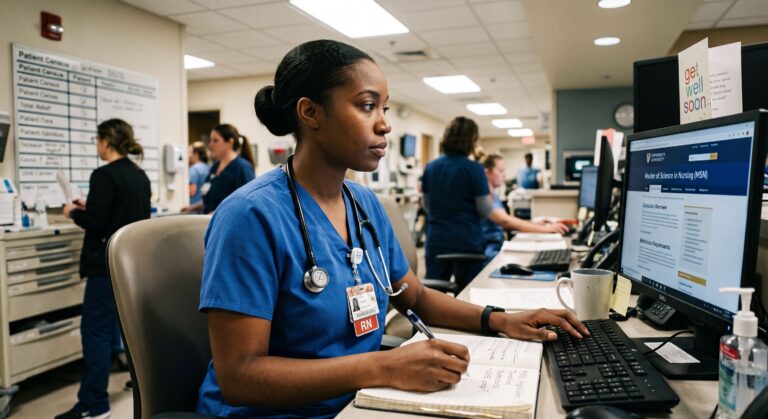
Direct-Entry Online MSN Programs: Become an RN and Earn a Master’s in 16–24 Months
Some direct entry MSN programs online combine online or hybrid coursework with required in-person clinical training, and some also require campus-based labs, simulation, or intensives….

Why Second-Degree Nursing Students Can’t Count on Pell — and What to Use Instead
Students entering an ABSN or another second-degree nursing program generally cannot rely on Pell Grants because they already hold a bachelor’s degree. Instead, they may…

Nursing Clinical Rotations Explained: What Really Happens During an ABSN
Clinical rotations are where nursing school starts to feel much more like nursing. ABSN students leave the classroom and skills lab and begin caring for…
Financial Aid for ABSN Students (2026 Guide)
Many accelerated Bachelor of Science in Nursing students face distinct funding challenges because they are pursuing a second bachelor’s degree. Although program costs can be…

Online ABSN Programs: Which Are Truly Online (and Which Are Actually Hybrid) in 2026
Students searching for what online ABSN programs are actually fully online should be cautious with the word “online.” In many accelerated Bachelor of Science in…

How Much Does an ABSN Program Cost? Tuition, Fees, and Ways to Pay (2026)
The ABSN cost varies by school, location, program length, delivery format, and institution type. Tuition is only part of the financial commitment; students may also…

Is an Accelerated Nursing Program Hard? The Real ABSN Workload
Is an ABSN program hard? Generally, yes—primarily because it compresses nursing coursework, labs, and clinical training into a shorter timeframe. How challenging the experience feels…

Can You Work While in an Accelerated Nursing Program? What to Expect Week to Week
Can you work while in an ABSN program? Yes, some students do, but whether it is realistic depends on the program’s pace, clinical schedule, job…